Horror
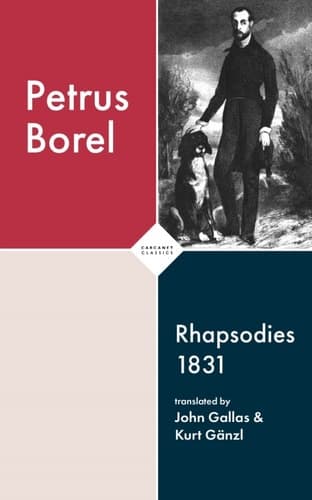
Rhapsodies 1831
2022·96 pages
Petrus Borel's *Rhapsodies 1831* captures the fiery, rebellious spirit of a young poet through a collection of intense, dark verses written in his early twenties. The poems brim with vivid imagery of danger, love, and injustice, reflecting Borel’s raw emotion and disdain for societal norms. This work, once scandalous and ignored, reveals the tormented genius of a forgotten Parisian dandy.
Owned
No reviews yet
Owned
Petrus Borel's *Rhapsodies 1831* captures the fiery, rebellious spirit of a young poet through a collection of intense, dark verses written in his early twenties. The poems brim with vivid imagery of danger, love, and injustice, reflecting Borel’s raw emotion and disdain for societal norms. This work, once scandalous and ignored, reveals the tormented genius of a forgotten Parisian dandy.
About
Details
'Borel was the sun,' said Théophile Gautier, 'who could resist him?' Indeed, who? A lycanthrope, necrophile, absurd revolutionary, Paris dandy with a scented beard, flamboyant sufferer: a man with no grave and no memorial. His once celebrated red mouth opened briefly 'like an exotic flower' to complain of injustice and bourgeois vulgarity; of his frustration in love and reputation; of poverty and blighted fate. Then he withered in the minor officialdom of Algeria, where he died because he would ...
What's Inside
will contain mild spoilers
Romance & sex
AI
Implied necrophilic themes in poetic imagery; no explicit on-page scenes but recurring dark romantic allusions to taboo desires.
Violence & gore
AI
Frequent depictions of daggers, cutlasses, danger, and calls to arms; gothic violence including implied body horror and revolutionary bloodshed.
Profanity
AI
Mild archaic strong language in poetic expressions of gall and suffering.
Substance use
AI
No substance use depicted.
LGBTQ+ Rep.
AI
No LGBTQIA+ representation.
Religious content
AI
No religious themes present.
Magic & witchcraft
AI
No evidence found in available sources.
Occult / demonology
AI
Occult elements like lycanthropy and necrophilic motifs in gothic, dark romantic framing; no rituals or summoning.
Political content
AI
Central revolutionary cries against injustice, poverty, and social critique in 19th-century France; pervasive calls to arms and howls of systemic inequality.
Self-harm / suicide
AI
Fleeting poetic ideation of despair and blighted fate; no on-page attempts.
Abuse & suffering
AI
Frequent plaints of systemic suffering, poverty, injustice, and blighted fates; emotional cruelty and societal abuse central to themes.
Other
AI
No information found